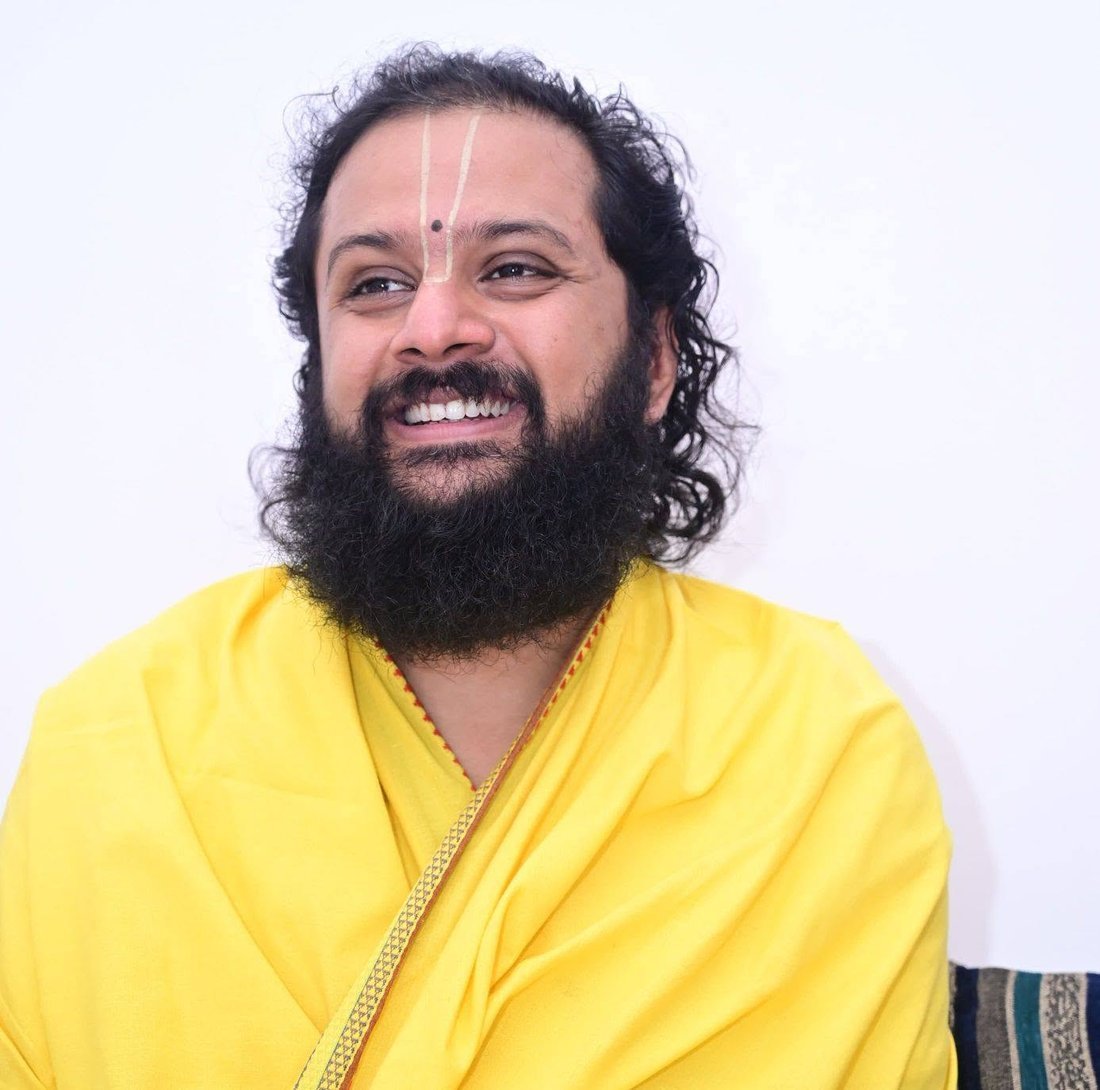
In an age when ancient wisdom is too often reduced to aphorism, and modern scholarship too often severed from lived devotion, Swami Shri Padmanabh Sharan Devacharya Ji Maharaj occupies a rare and singular position: that of a bridge. He is, at once, a disciple within an unbroken spiritual lineage stretching back more than five millennia, and a contemporary Vedic scholar conversant with the language and expectations of modern academic life.
He is a disciple of the 48th Jagadguru Nimbarkacharya, Shri Radha Sarveshwar Sharan Devacharya Ji Maharaj, and bears the title Anant Shri Vibhushit Jagadguru Nimbarkacharya Vithi Pathik Acharya Mahamandleshwar Shri Mahant — a Spiritual Leader guiding thousands toward the practice of devotion, a Vedic Scholar trained in the six classical schools of Indian philosophy, an Acharya Mahamandleshwar formally recognised before the great Akhadas of Sanatan Dharma, and a Trust Founder whose institution, Shri Sarveshwar Seva Dham, translates contemplative teaching into ground-level humanitarian service.
What follows is the arc of that calling: from a childhood steeped in Vedic values, through a Gurukul education spanning Sankhya to Vedanta, into public life as one of India's most sought-after voices on Shrimad Bhagwat, Shri Ram Katha, and Vedic astrology.
The Journey
A single thread of Prema Bhakti, carried forward with reverence for both tradition and scholarship.
Birth & Early Life in Chhoti Kashi
Born in Jaipur into a Shrotriya family of the Khandal-Vipra Vansh, in the old quarter known since antiquity as Chhoti Kashi — the "Lesser Kashi" — recognised for its density of temples and its centuries-old culture of Vedic learning. Sanskrit shlokas were the first language of the household, and devotion was the ambient condition of daily life rather than an occasional practice. From his earliest years, he gravitated toward Bhakti and the deeper wells of Vedic wisdom — what the Sampraday itself would later regard as a period of divine incubation.
Initiation into the Nimbark Sampraday
His childhood Diksha came directly from Anant Shri Vibhushit Jagadguru Nimbarkacharya Shri Shri Radhasarveshwar Sharan Devacharya Ji Maharaj — the 48th Acharya of the Sampraday — whose own grace and guidance would shape the decades that followed. The Nimbark Sampraday holds that the deepest transmissions occur not when the intellect is most developed, but when the heart is least guarded, and a child received into initiation carries that imprint across a lifetime of practice. He has, since that early initiation, been blessed by great saints, Vaishnavacharyas, and Shankaracharyas alike.
The Six Schools of Classical Philosophy
Under his Guru's direct guidance, he undertook rigorous, sequential immersion in the Shad Darshana — the Six Schools of classical Vedic philosophy — each a complete system studied fully before moving to the next, in the traditional manner few outside Gurukul settings ever complete.
Sankhya
Enumeration of Purusha & Prakriti — consciousness and primal matter.
Nyaya
Logic and epistemology — the discipline of valid inference.
Mimansa
Exegesis of Vedic ritual injunction and scriptural authority.
Yog
Patanjali's path of discipline, concentration & liberation.
Vedant
The culminating philosophy of the Upanishads and Brahma Sutras.
Vaishaishik
The atomistic school — categories that constitute reality.
This six-fold training was never abstract exercise — it was pursued throughout in active worship of Lord Sarveshwar, understood through Dwaitadwait, the principle that distinguishes the Nimbark Sampraday from every other Vedantic school.
Adjunct Professor of Philosophy, NIMS University
Alongside his Vedic training, he pursued formal academic study in parallel, culminating in a Master's in Philosophy. This bridge between tradition and contemporary academic life found public expression in his appointment as Adjunct Professor of Philosophy in the NIMS School of Humanities & Social Sciences at NIMS University Rajasthan, Jaipur — conferred by the University's Chairperson on recommendation of the Academic Council, in recognition of his contribution to Vedic Philosophy, Vedic Astrology, and Vedic Meditation and Yoga.
He also pursued specialised study in Vedic Astrology, mastering both the classical Parashari system and the more analytically demanding KP (Krishnamurti Paddhati) system, extending into Vedic Science and palmistry.
Sacred Solitude — Tapasya in the Himalayas
Public discourse is only the visible half of an Acharya's practice. Maharaj Ji has performed extensive Upasanas and Sadhanas across some of the most demanding settings Sanatan Dharma sets aside for austerity: deep forest, the high solitude of the Himalayas, remote Gufas cut into bare rock, and dedicated Tapasthalis marked by the Dhooni — the sacred fire tended without interruption. Among these, one period is remembered as especially demanding: three continuous years of unbroken Tap at a remote Tapasthali, away from all public life.
It is from this solitary practice that his mastery of Swar Yoga — the subtle science of breath and its correspondence with cosmic rhythm — is understood to arise, lending an accuracy to his astrological readings that has drawn a following extending across India and into several foreign countries.
Peethabhishek at the Vaishnav Baithak, 2021
In 2021, at the Vaishnav Baithak in Shri Vrindavan Dham — the sacred town regarded as the very heart of Krishna devotion in India — Maharaj Ji was anointed with his complete and current title: Anant Shri Vibhushit Jagadguru Nimbarkacharya Vithi Pathik Acharya Mahamandleshwar Shree Mahant. The designation was granted in the collective presence of all three prestigious Ani Akhadas — Shree Nirmohi Ani, Shree Digambar Ani, and Shree Nirwani Ani — a consensus of authority that is exceedingly rare within the Vaishnava fold.
Designations & Distinctions
He serves as Patron of the Akhil Bhartiya Vidwat Parishad — the apex national body headquartered in Varanasi that unites Sanskrit and Vedic scholars, university professors, and Dharmacharyas across India — and as Parmaadhyaksh (President) of Shri Nimbark Parishad, Jaipur, the administrative body carrying the Sampraday's own institutional life forward. He was formally felicitated at the Vidwat Parishad's 24th Samman Samaroh at Kashi, introduced by his full designation as Peethadhishwar of Shri Sarveshwar Dham and Acharya Mahamandleshwar.
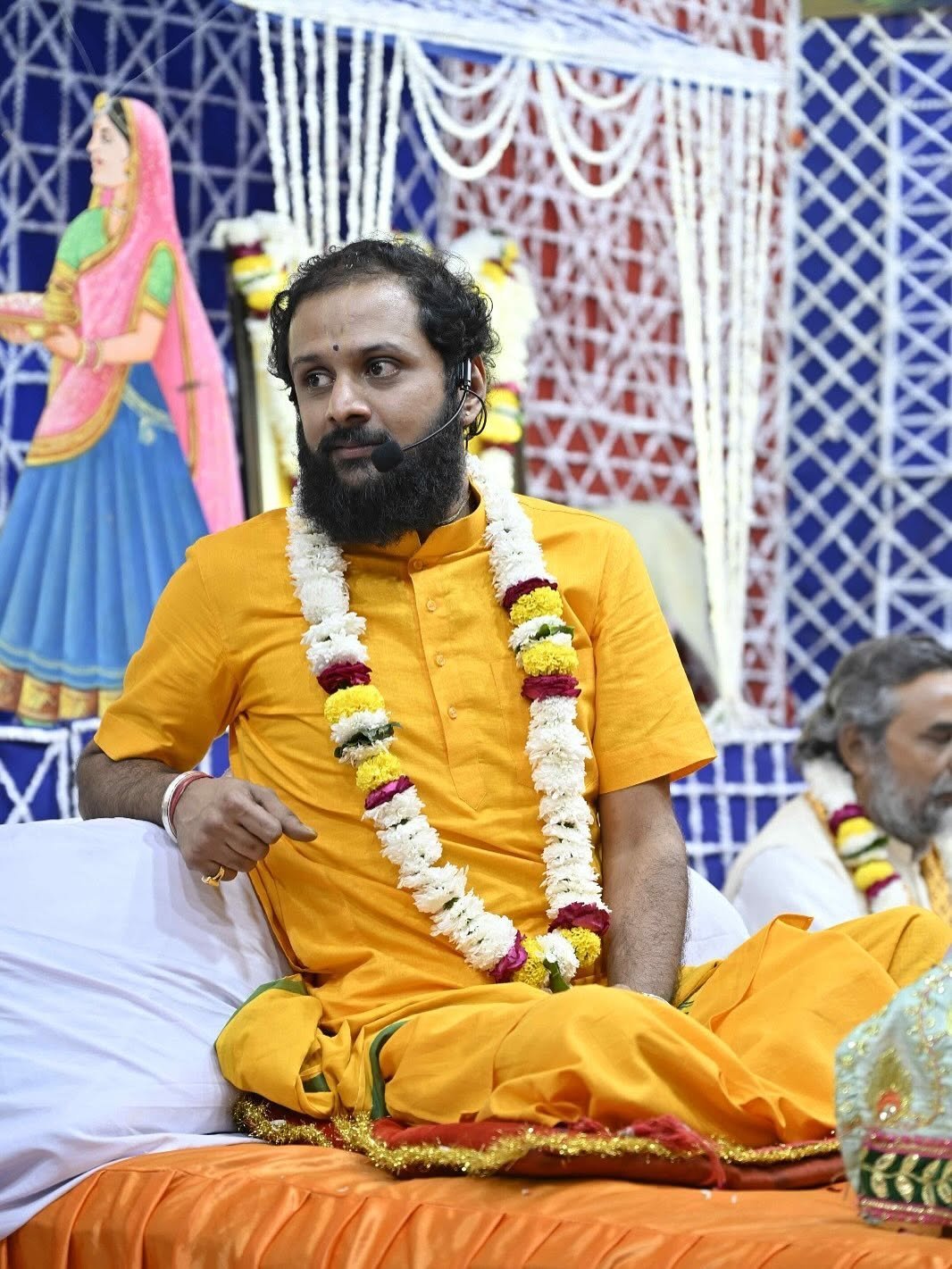
Mastery of Discourses — Kathas & Scriptural Elaboration
Public life, for an Acharya, is conducted almost entirely through the spoken word — and it is on the Vyasapeeth, the seat from which scripture is expounded, that Maharaj Ji is most widely known. He has carried his eloquence into more than 140 Shrimad Bhagwat and Shri Ram Katha events across his teaching life, educating gatherings that regularly exceed ten thousand listeners.
What distinguishes his Kathas is a particular capacity the tradition prizes above almost any other: the ability to remain, for several consecutive days, inside a single Sanskrit shloka — turning it, examining it from successive angles, drawing out layers of meaning an ordinary reading would pass over in seconds. His command extends across the eighteen Puranas, the eleven principal Upanishads, the Brahmasutra, the Bhagavad Gita, the Shrimad Bhagwata, the Valmiki Ramayana, the Yog Vashishta, and more.
See Upcoming ActivitiesContinue the Journey
Discover the philosophy Maharaj Ji teaches, and the Guru Parampara he carries forward.